





Introduction
6-aminocaproic acid is also known as aminocaproic acid, ε-aminocaproic acid, and antifibrinolytic acid, with a chemical formula of H2NCH2(CH2)3CH2COOH and a molecular weight of 131.18. It's white crystalline powder, odorless, bitter taste. The melting point is 202-207°C (decomposition). It's soluble in water, slightly soluble in methanol, insoluble in ethanol, ether, chloroform. It is an antifibrinolytic drug. Fibrinogen specifically binds to fibrin through the lysine binding site in its molecular structure, and then becomes plasmin under the action of an activator, which can cleave the arginine and lysine peptide chains in fibrin , forming fibrin degradation products that dissolve blood clots. This product can inhibit the combination of plasminogen and fibrin, prevent its activation, thereby inhibiting fibrinolysis, high concentration can directly inhibit the activity of plasmin, and achieve hemostatic effect.

Preparation Process
Caprolactam obtained by hydrolysis. Add caprolactam, concentrated hydrochloric acid and 3 times the amount of distilled water into the reaction tank, stir, heat up and reflux for 1.5 hours, and control the temperature at 103-106°C. After the reaction, the measured conversion rate should reach more than 95%. Add distilled water to dilute to 10% concentration to obtain 10% 6-aminocaproic acid hydrolyzate. Flow the hydrolyzate evenly into the ion exchange column [packed with 001×7 (732#) strongly acidic styrene-based cation exchange resin] at a flow rate of 5-10L per hour for adsorption. After the flow is over, close the outlet and soak overnight. Wash the ion-exchange column with distilled water to remove hydrochloric acid (check the effluent to be free of chloride ions). Then, evenly flow 3.5% ammonium hydroxide at a flow rate of 5-10L per hour. After the flow is finished, close the outlet and soak overnight. The next day, continue to finish the ammonium hydroxide, flow into distilled water for elution, and collect the eluate containing 6-aminocaproic acid. Add activated carbon for decolorization, filter, and concentrate the filtrate under reduced pressure at 47-70°C to nearly dryness. Add ethanol while it is hot, and stir to precipitate crystals. After cooling, shake and filter to obtain the crude product. Dissolve the crude product in distilled water, add activated carbon and decolorize at 60°C for 1h. Strain while hot. The filtrate was concentrated under reduced pressure to nearly dryness. Add ethanol to precipitate crystals, cool, filter, wash the crystals with ethanol, and dry to obtain 6-aminocaproic acid.
Identification
(1) Take this product and aminocaproic acid reference substance, add water to make a solution containing 2.5mg per 1ml, and test according to the method of thin layer chromatography (Appendix 26). Absorb 2 μl of each of the above two solutions, and spot them on the same silica gel G thin-layer plate (activated at 105°C for 1 hour before use). Another ethanol-water-concentrated ammonia solution (100:14:14) was used as the developer, after development, it was dried in the air, sprayed with 0.2% ninhydrin water-saturated n-butanol solution, dried at 100°C for 15 minutes, and tested The color and position of the main spots displayed by the substance solution and the reference substance solution should be the same.
(2) The infrared absorption spectrum of this product is consistent with the spectrum of the comparative "Infrared Spectrum Collection of Drugs".
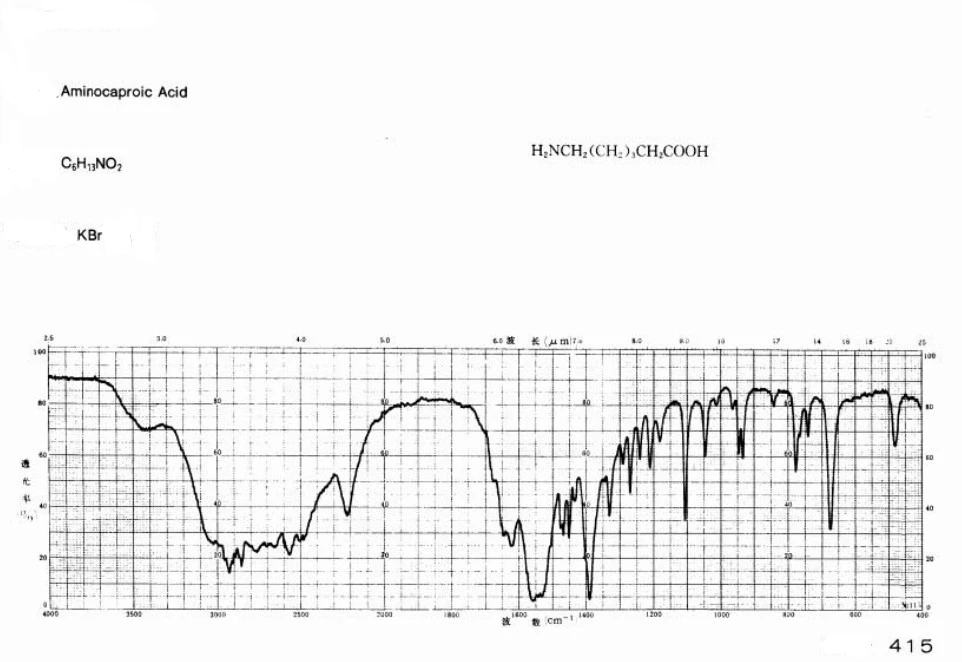
Check
Clarity of the solution Take 1g of this product, add 20ml of freshly boiled cold water to dissolve, and compare with the turbidity standard solution No. 1, it must not be thicker.
Alkalinity: Take the solution under the item of clarity and measure according to the law (appendix page 33), the pH value should be 7.0~8.0.
Sulphate :Take 1g of this product and check according to the law (appendix 35). If turbidity occurs, it should not be more concentrated (0.01%) than the control solution made of 1ml of standard potassium sulfate solution.
Loss on drying :Take this product and dry it to constant weight at 105°C, the weight loss should not exceed 0.5% (appendix page 40).
Residue on ignition : Take 1g of this product, check according to law (appendix page 42), the residual residue should not exceed 0.1%.
For calcium salt, take 1g of this product, add 20ml of water to dissolve, add 2ml of ammonia test solution, shake well, and divide it into two equal parts; add 1ml of ammonium oxalate test solution to one part, add 1ml of water to the other part, shake well, and let it stand for 5 minutes , the two liquids should be equally clear.
Heavy metals: Take the residue left under the item of residue on ignition and inspect it according to the law (Method 2 on page 38 of the Appendix), and the heavy metal content should not exceed 10 parts per million.
Arsenic salt : Take 1g of this product, add 23ml of water to dissolve it, add 5ml of hydrochloric acid, check according to the law (Appendix 39), the arsenic content should not exceed 2ppm.
Determination
Take about 0.2g of this product, weigh it accurately, add 5ml of formaldehyde solution to dissolve, add 20ml of ethanol and 2 drops of phenolphthalein indicator solution, and titrate with sodium hydroxide solution (0.1mol/L); 15ml of cold water, add 5ml of formaldehyde solution and 20ml of ethanol for blank test correction, that is. Every 1ml of sodium hydroxide solution (0.1mol/L) is equivalent to 13.12mg of C6H13NO2.
Function and use
1. Used as a biochemical reagent;
2. Used in organic synthesis. For anti-fibrinolytic enzyme reagents. Used as a hemostatic drug.
3. It has obvious curative effect on some severe bleeding caused by increased fibrinolytic activity. It is suitable for oozing or local bleeding during various surgical operations.
4. It is also used for hemoptysis, gastrointestinal bleeding and hemorrhagic diseases in obstetrics and gynecology.
5. It works by inhibiting the fibrinolytic system. It is mainly used for bleeding caused by increased plasmin activity, such as obstetrics and gynecology bleeding, and bleeding after internal operations on the prostate, liver, pancreas, and lungs. Early intraoperative medication or preoperative medication can reduce bleeding during surgery and reduce the amount of blood transfusion.